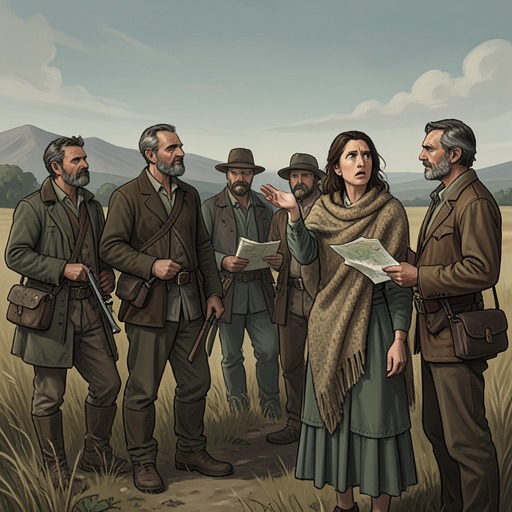
The Nilsson family’s decision to emigrate to America
The EmigrantsThe Nilsson family’s decision to emigrate to America is the turning point that converts Karl Oskar’s private hopes into a shared family departure. It emerges from years of debt and unproductive labor, but is tested against Kristina’s fear for their children, the ocean’s dangers, and the absence of trustworthy knowledge about the destination. Anna’s death changes the balance: Kristina, who had resisted emigration in the name of parental responsibility, agrees to go, and the couple’s choice sets a course the narrative extends to descendants not yet born.
Background: A movement taking root
The family’s decision belongs to a broader movement gathering in peasant communities. News of abundant land travels by rumor, books, pictures, and neighborly exchange into places where holdings are shrinking as families grow. The idea of departure takes root unevenly: the familiar home feels safe, the ocean is unknown, and arguments divide the cautious from the daring, women from men, and the old from the young. The Nilssons’ choice is therefore both intimate and representative, one household’s response to the restless new possibility reaching the Swedish countryside.
The group from Ljuder Parish does not share one cause for leaving. Crop failure, persecution by civil authorities, religious dissent, personal troubles, social ostracism, and unfair employment practices supply distinct pressures. The Nilssons’ own deliberation centers on debt, restricted prospects, and the future of their children. Their decision makes visible how a group migration can gather people whose reasons differ even when they travel toward the same continent.
Karl Oskar’s case for departure
An image concentrates Karl Oskar’s hope. After breaking his plow on a stone, he returns from the field unusually early and sits indoors instead of making a replacement. He wipes his fingers before handling borrowed paper from the churchwarden, then studies the picture titled “A Wheat Field in North America.” Its level, seemingly boundless field has no visible stones, hills, or fences; sheaves of full grain stretch toward the horizon. For Karl Oskar, the image gives material form to a contrast with the stony land he works at home. Although he shows the picture to Kristina, she looks at it casually; she cannot know that he carries it in his mind.
His argument is not simply that America will be easier. He expects fertile, stone-free land to cost very little, and believes that he and Kristina can turn their strength and farming skill into an improved livelihood. The work may be as hard as in Korpamoen, but he imagines it undertaken with hope and the possibility of progress. At home, four years of labor have left the couple several hundred riksdaler poorer. Continuing, he argues, would mean wearing themselves down without improving their condition, until the reserved room and meager bread of old age were all their work had secured.
The children’s prospects sharpen his case. One child might inherit the farm; the others, he fears, would have to hire themselves out as farmhands or become squatters. He sees no third option in a crowded countryside where laborers compete for work and poor families live in rickety forest huts, sometimes without bread. If he and Kristina feel responsible for their children, he reasons, they must take them away from this constricted future. His desire to leave thus joins personal ambition to a parent’s fear that hard work at home will not protect the next generation.
Kristina’s objections and the struggle to agree
Kristina’s opposition rests on the same concern for the children, not indifference to their future. Karl Oskar has no land deed awaiting him, no written promise from those who govern in America, and no firsthand testimony from anyone they know who has been there. Printed accounts and pictures do not reassure her. If emigration is truly advisable for young farm families, she wonders, why can he name no farmer who has already gone with wife and children? His confidence, to her, rests on claims that have not been tested by a trustworthy witness.
She also insists on the risks he has not faced in his hopeful picture. The family would have to cross the ocean in a fragile ship; they might never reach America alive. Their children are too young to consent to a voyage that could end beneath the sea, and Kristina questions whether the parents have the right to expose them to that danger when they are not forced to leave. The family would also lose the daily presence of parents, siblings, relatives, and friends, entering a place where every person was a stranger and they could not speak the language. What Karl Oskar imagines as a chance to build a livelihood, she sees as a risk of isolation as well as physical peril.
For many autumn evenings, they return to the question while working by the fire. Karl Oskar whittles ax handles and wooden rake teeth; Kristina cards wool and spins flax. She repeatedly falls back on the absence of anyone known to have emigrated. He answers that someone must go first and accepts that the responsibility is his. Their exchange makes the decision a contest over uncertainty and accountability: neither spouse claims knowledge of what awaits the family, but Karl Oskar is prepared to act without guarantees.
Kristina believes that he has always persisted when he made up his mind, even when defying her and his parents, but this time she expects him to yield. She asks Nils and Märta to help dissuade him. They sympathize with their son’s wife but decline to intervene: Nils observes that Karl Oskar has never sought his parents’ advice since he was old enough to dress himself, and would only become more stubborn if they tried to influence him. The family’s resistance therefore does not dissolve Karl Oskar’s resolve; the question remains between husband and wife.
Bereavement changes the decision
Anna’s death shifts the meaning of danger for Kristina. For weeks after the funeral she is crushed by grief and repeatedly reproaches herself over the christening porridge: she thinks that hiding the bowl or letting the children taste it first might have saved Anna. The parents do not speak the dead child’s name, keeping their sorrow in silence rather than exposing it to words that, they feel, would deepen the pain.
A month after the funeral, Kristina tells Karl Oskar that she has changed her mind. She had believed that a responsible mother must not endanger her children’s lives on the ocean. Now she has learned that, despite her care, God can take a child on dry land too. She reasons that the children may be as safe on a stormy sea if entrusted to the Highest. She also knows that she will never again feel the same in Korpamoen. Her consent is not a claim that the voyage is safe or that America is certain to fulfill Karl Oskar’s hopes; it is a decision to share his course despite what neither of them can know.
The couple agree to seek passage in the following spring. The narration presents their agreement as more than a household arrangement: it will determine their lives and their children’s fate, extending in consequence to the birthplace of grandchildren and great-grandchildren. The scale of that projection gives the private conversation historical weight. A choice made under grief and uncertainty becomes a change in the family’s place in the world across generations.
From intention to departure
Once the decision has been made, the family must make departure materially possible. Karl Oskar and Robert arrange passage through a firm in Karlshamn on the Charlotta, a merchant vessel carrying cargo and emigrants. Spring is chosen so the family can cross after the winter storms and arrive early enough to till and sow for a harvest before winter. Karl Oskar sends a down payment of one hundred daler for passage for six people; the plan is to embark in the second week of April and sail directly to New York. A decision founded on an imagined field now has a route, a ship, a season, and a payment attached to it.
Selling Korpamoen reveals how narrow the family’s financial margin remains. Karl Oskar receives one hundred and fifty daler less for the farm than he had paid, while the cattle fetch good prices because animals are scarce after the slaughter during the famine year. The auctioneer, Per Persson, retains a quarter of the proceeds as the cost of advancing the money. After the mortgage and other debts are deducted, the family has 1,200 daler. Passage for three adults and three children costs 675 daler, leaving Karl Oskar about 500 daler before entry charges and the unknown cost of traveling onward to their settlement. His expectation of cheap land must therefore coexist with little money for farm implements and cattle. Kristina sews the remaining money into a sheepskin pouch that Karl Oskar can fasten to his belt and carry against his body.
The departure also distinguishes Karl Oskar’s situation from Robert’s. Robert has escaped service and dares not approach the dean for papers. Karl Oskar, by contrast, wants to leave openly rather than as though he has done wrong; he goes to Dean Brusander to request the documents for himself and his household. Emigration depends not on hope alone but on household consent, money, transport, and the ability to pass through the institutions of the home parish.
The crossing gives the decision its physical cost. The brig Charlotta sails from Karlshamn on April 14, 1850, carrying 78 emigrants among 94 people aboard, and the Nilssons’ hope of a new livelihood begins in a hold crowded with bedding, food baskets, and bundles. The emigrants receive weekly portions of unprepared provisions and must keep their quarters clean; fresh water is rationed to half a gallon per person each day, withheld until the morning cleaning is done. When the ship’s prolonged passage, illness, and confinement have worn down the passengers, sighting green land near New York renews their energy. The ordeal does not prove that Karl Oskar’s picture was a guarantee. It shows instead what the family’s decision required them to endure before they could test the promise of another life.